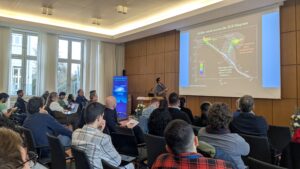
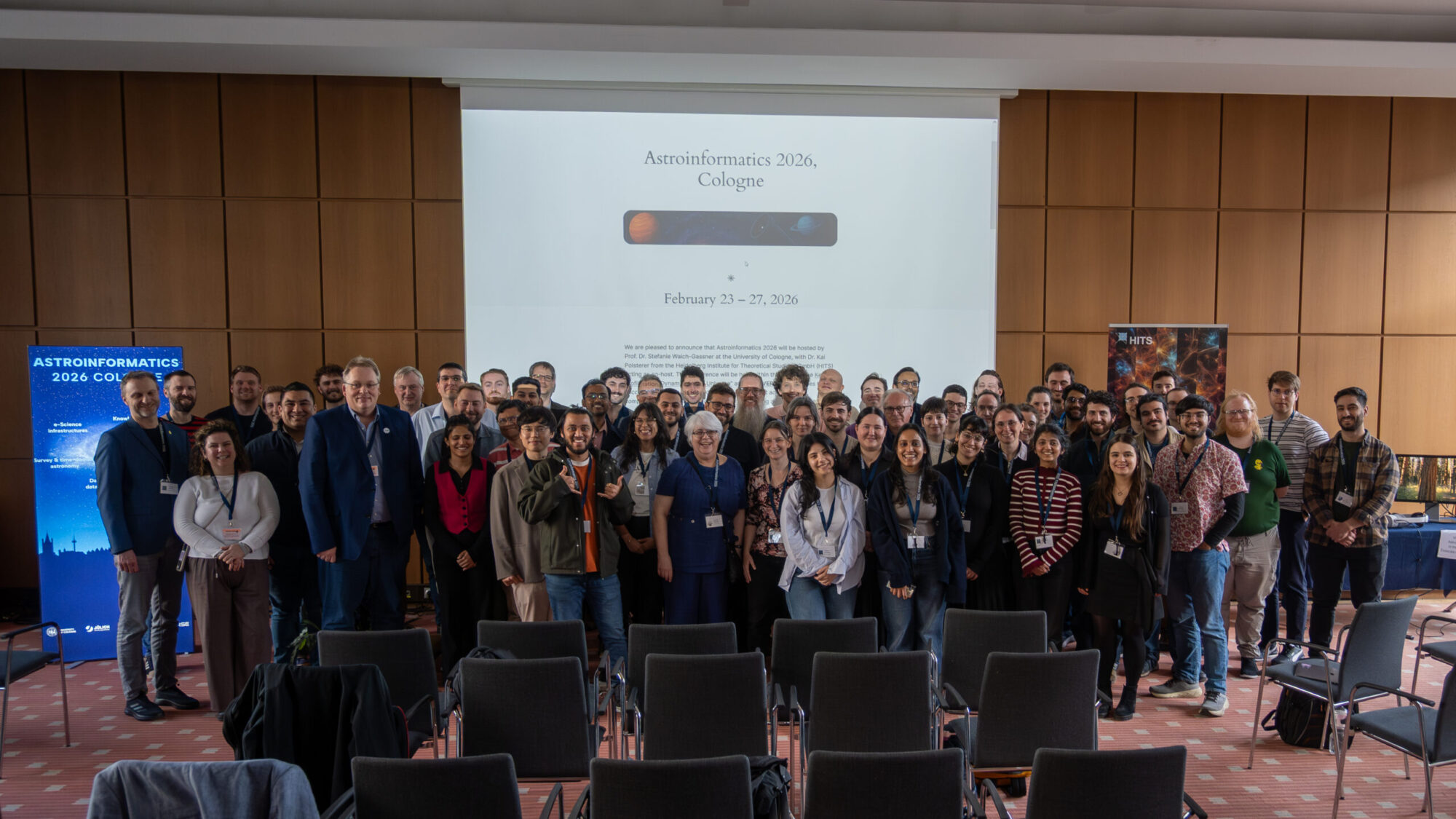
Last week, more than 50 participants gathered at the University of Cologne for the launch of our new conference series, “Astroinformatics”. The event brought together researchers from across the Rhine region and as far as Cape Town for several days of inspiring discussions at the interface of astrophysics, data science, and artificial intelligence.
The conference was structured around six main thematic blocks. Each block featured an invited keynote speaker, followed by contributed talks expanding on the topic.
Machine Learning for Cosmology
The invited speaker Ofer Lahav from the University College London explored the interplay between AI for Astronomy and Astronomy for AI.
Exascale Computing and FAIR Data Platforms
Andreas Lintermann from the Forschungszentrum Juelich provided an overview of high-performance computing and gave recommendations for scalable AI for physics applications and simulation workflows.
Confronting Models with Data
Natalia Korsakova from the Observatoire de la Cote d’Azure spoke about the capabilities of the Laser Interferometer Space Antenna (LISA).
Data-driven Discovery
Anna Scaife from the University of Manchester explained how we can use large-scale surveys to build foundational representations.
AI/NLP for Workflows and Education
This topic was introduced by Lucie Flek from the University of Bonn talking about the promises, pitfalls and practices of LLMs/LLM agents in astrophysical workflows.
Survey and Time-Domain Data
This part of the conference was divided into several sections with two invited speakers. Guillermo Cabrera-Vives from the University of Concepción stressed why one modality is not enough to capture the full complexity of astrophysical phenomena. Having traveled a long way to join our conference, Michelle Lochner from the University of the Western Cape complemented the previous talk and gave an overview on how machine learning can be used for automating the discovery of astronomical phenomena.
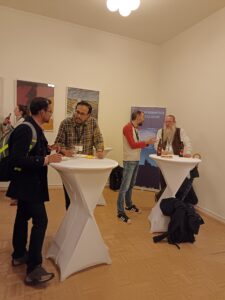
Between the talks, our guests and speakers had the opportunity to take part on a poster session and discuss the introduced topics, from magnetic resonance imaging, design-based research, following tracers in star formation simulations and simulations of local large-scale structure, several visualization tools with Python, as well as platforms for the analysis of astronomical data.
To engage the audience, we held panel discussions at the end of each day and a final discussion on the last day. Detailed information on all talks and posters can be found here.
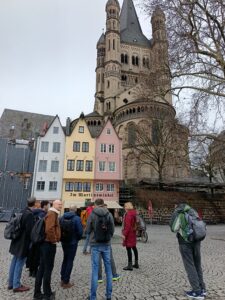
The program also included social events such as a walking tour through the historical center of Cologne, a conference dinner and a visit to the monthly “Astronomy on Tab” event on Thursday evening.
We are looking forward to continue the conference series next year and are excited about the future developments in the field of Astroinformatics. Stay tuned!
Photo Credit: Beth Jones