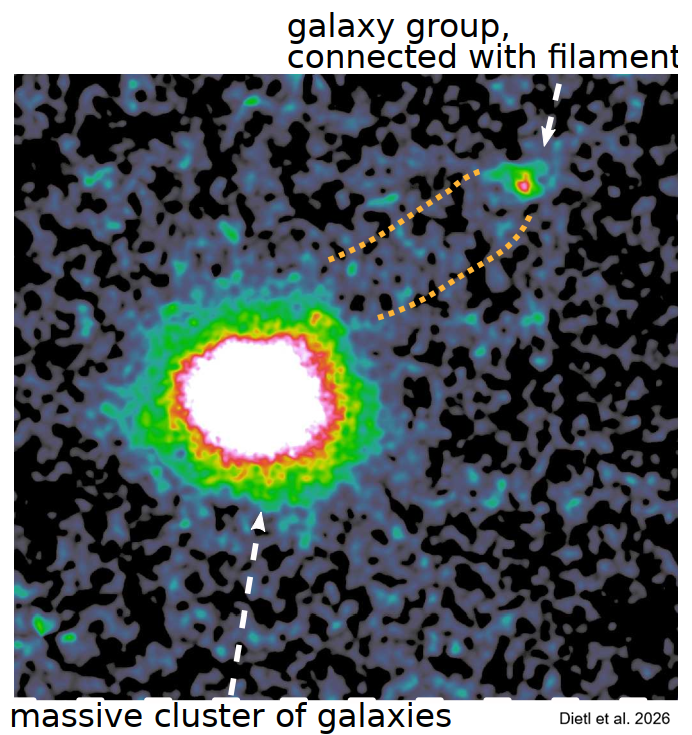
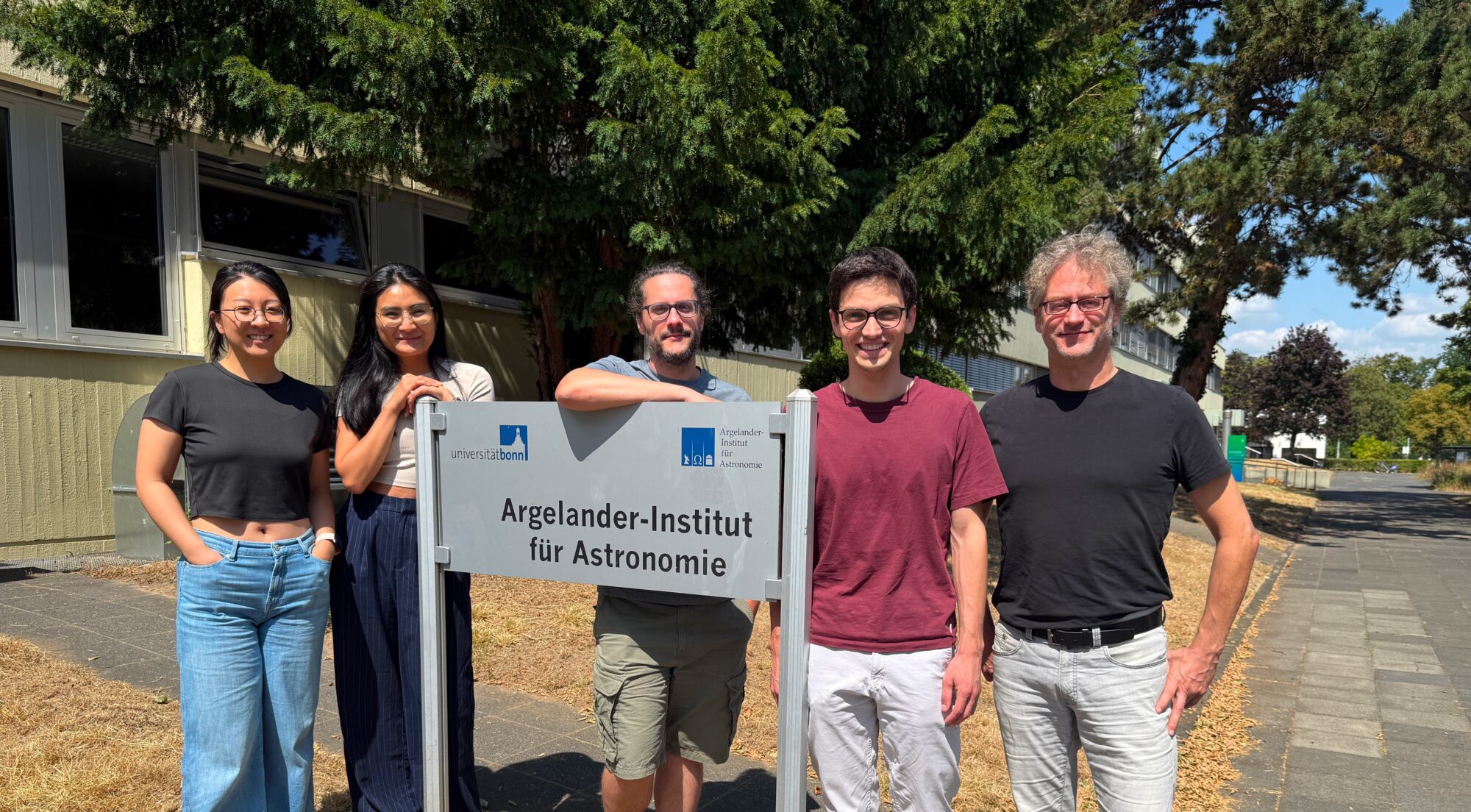
As the second eROSITA data release expands the catalogue of the X-ray sky, a team of Dynaverse researchers at the University of Bonn has analyzed a massive galaxy cluster and its cosmic filaments
The German eROSITA consortium (eROSITA-DE), which also includes the University of Bonn and which is being led by the Max Planck Institute for Extraterrestrial Physics (MPE), has released its second major public dataset, the “eROSITA Data Release 2” (DR2). Built from the first three all-sky surveys done by the eROSITA telescope aboard the Spectrum-Roentgen-Gamma (SRG) mission, DR2 provides the most sensitive and comprehensive catalogue of the X-ray sky currently available to the public. Spearheaded by Dynaverse researchers at the University of Bonn, the analysis of a massive galaxy cluster has shown that the theoretical models for how the Universe formed largely match the observations made, albeit with some interesting discrepancies in the finer details.