
We offer internship opportunities for bachelor’s and master’s students, who would like to gain research experience in astrophysics, computer science, and mathematics, and contribute to scientific progress within the cluster.
Successful applicants will spend up to three months working on a selected research project within one of our research groups in Cologne, Bonn, or Jülich. In addition, students will have the opportunity to interact with junior and senior researchers across the cluster and learn more about the research activities of Dynaverse.
The cluster provides financial support and assistance in administrative issues. Interested students can apply once a year and join the research group of their choice for a 10 -12-week internship during the summer. The call for summer 2027 is open now – application deadline is November 15. Below you can find more information about the program and the offered projects. If you have any further questions do not hesitate to contact Dr. Magda Baer Radermacher.

test 2
General Information
When:
- 2-3 months between May and September
Who can apply:
- We welcome applications from excellent international and German students who will have completed at least four semesters of (astro)physics or a related field by the beginning of the internship. Please also check the specific requirements listed in the individual project descriptions.
- Previous research experience is not required. We are primarily interested in students with a strong academic background, curiosity, motivation, and the ability to learn and work independently.
How to apply:
- Students interested in joining us in summer 2027 can apply by November 15, 2026. Detailed information about the application process can be found in the Application section.
- Final admission decisions will be announced in mid-January 2027.
Financial support:
- Accepted students will receive reimbursement of travel costs of up to €700 (€1,000 for overseas applicants) and an internship allowance of €992 per month.
- The program coordinator will also provide support with administrative matters related to the internship.
test 1
Useful Information
University Enrolment
- All interns from non-German universities will be enrolled as short-term students at the University of Cologne. This requires the submission of additional documents and payment of the applicable semester fee.
- The semester fee allows visiting students to use regional public transportation, including the Deutschlandticket, as well as university facilities such as canteens and sports centres. We will provide accepted students with detailed information about the enrolment process and the associated fees.
Accommodation
- We do not arrange accommodation for program participants. However, we can assist students in finding accommodation, for example in shared flats or student residences, where available. Students are responsible for arranging and paying for their own accommodation.
- Please note that finding accommodation in Cologne and the surrounding area can be challenging. We therefore strongly recommend starting your search as soon as you are accepted into the program. We will provide accepted students with more detailed information and guidance on how to proceed.
Useful information on housing & costs of leaving can be found on the universities websites:
- Cologne: https://uni-koeln.de/en/studying-teaching/international/study-in-cologne/accommodation-for-international-students
- Bonn: https://www.uni-bonn.de/en/university/university-life/living-in-bonn?set_language=en
Health and Other Insurance
- Please make sure that you have valid health insurance coverage in Germany for the entire duration of your internship.
- We also recommend having accident insurance and personal liability insurance for the duration of your stay.
test 3
List of Projects
Project 1: Expanding the SUE Platform by a Novel DYNAVERSE Astrophysics Workflow
Host: Dr. Tanjona R. Rabemananjara
Location: Jülich Supercomputing Centre (JSC), Forschungzentrum Jülich
Requirements for applicants:
- At least 4 completed semesters in physics, computer science, applied mathematics, or a related field
- Familiarity with Python programming; comfort reading and adapting unfamiliar scientific codebases
- Basic familiarity with structured data formats and command-line/HPC environments (Slurm or similar)
- Willingness to work directly with the researcher who owns the target code, to correctly characterize its behaviour
- Some background in numerical simulation and/or ML is a plus
Description: By the time the internship begins, SUE will have several working proof-of concept pipelines (astrophysics workflows spanning simulations, ML analysis, and visualization), each fully described as a chain of registered components with machine-readable contracts and executed end-to-end through the SUE Workflow System on JSC’s HPC. The main aim of this project is thus to test whether that framework generalizes beyond these initial use cases.
The intern will take a different astrophysics code/workflow already in use (or of interest) by a Dynaverse subgroup and integrate it into SUE, following the pattern established by the existing Lighthouse Projects’ pipelines:
- Study the existing SUE component contract schema and the reference Lighthouse Projects’ implementations as a template.
- Work with the code’s owning group to characterize its inputs/outputs, dependencies, and software environment, and write a formal contract for it.
- Register the new components and assemble a SUE Workflow Description (DAG) for the chosen pipeline, reusing the existing Workflow Engine and Resource Manager.
- Run the workflow end-to-end on JSC’s HPC.
The concrete deliverable is another working, registered SUE workflow. Beyond the working workflow itself, the intern will produce documentation of the integration process, capturing any friction points, adaptations, or edge cases encountered along the way. This contributes practical evidence toward SUE’s interoperability goals across diverse astrophysics codes/workflows
Project 2: Tracing Hidden Molecular Gas in the Large Magellanic Cloud with MeerKAT telescope
Host: Dr Sarwar Khan (Group of Prof. Arshia M. Jacob)
Location: University of Cologne
Requirements for applicants
- At least 4 completed semesters in physics or related fields of study
- Completed courses covering atomic and molecular physics as well as computational physics
- Basic knowledge of Python and scripting.
- Comfortable working in a Linux environment.
- Very basic understanding of telescopes and astronomical observations.
- Familiarity with atomic and molecular structure, and spectral-line emission is an
- advantage.
Description: Carbon monoxide (CO) is one of the most commonly used molecules for tracing molecular gas in space. However, it does not work well in diffuse and translucent regions, especially in low metallicity environments. In these environments, CO is easily broken apart by ultraviolet radiation, while H₂ can survive because it protects itself more effectively. This means that a significant amount of molecular gas can remain invisible in CO observations. We call this “CO-dark” molecular gas (DMG).
Understanding how much CO-dark gas exists and what its physical properties are is important for understanding how molecular clouds form and how stars are born. In this project, we will study CO-dark gas in the Large Magellanic Cloud (LMC), a nearby low-metallicity galaxy that provides an excellent environment for studying star formation under conditions different from those in the Milky Way.
We will use the MeerKAT radio telescope to observe the 3.3 GHz emission from the methylidyne (CH) molecule, which is a useful tracer of CO-dark molecular gas. We will focus on four starforming regions in the LMC that represent different stages of star formation. By combining the CH observations with data from other wavelengths, we aim to estimate how much molecular gas is COdark and investigate its physical properties.
During the internship, the intern will image and analyze the MeerKAT radio-interferometric data from one of these star-forming regions. This project will provide the high resolution interferometric observations of CH in the LMC and help us better understand the molecular gas available for star formation in low-metallicity environments.
Project 3: The scintillation properties of repeating Fast Radio Bursts
Host: Dr. Laura Spitler
Location: Max Planck Institute for Radio Astronomy (Bonn)
Requirements for applicants
- At least 4 completed semesters in physics or related fields of study
- Familiarity with Python programming and standard computational libraries (e.g. numpy, scipy, matplotlib)
- Comfort with learning and acquiring new skills, e.g., in Linux, academic writing, and advanced physical concepts and equations.
Description: Scientific background: Fast radio bursts (FRBs) are luminous flashes observed at radio wavelengths whose origins are not yet fully understood. What is well-known is that FRBs originate in distant galaxies, and therefore travel through several spatially distinct regions of ionized matter on their way to us, which include the interstellar media of their host galaxies, the intergalactic medium, and the interstellar medium (ISM) of the Milky Way. These ionized media alter the radio waves in various ways, such as introducing a frequency-dependent propagation speed (dispersion) or changing the plane of polarization (Faraday rotation). If small-scale structures with a non-zero density gradient (so-called “scattering screens”) are present, the radio waves will also undergo multi-path propagation, which is observable as scintillation in the spectrum.
The origin of small-scale ionized structures in the ISM of our galaxy is still an open question. FRB observations enable not only studies of scattering screens present in the Milky Way, but also potentially studies of those in their host galaxies, and perhaps most interestingly, in the material in the immediate vicinity of the sources themselves. Repeating FRBs are particularly scientifically valuable, because they not only probe all Galactic and extragalactic material along their propagation paths, but also allow us to investigate temporal changes in scattering and scintillation properties caused by the proper motions of intervening media, the source or the Earth, potentially providing an important new avenue for understanding their origins.
This project aims to study the time-variable scintillation properties of repeating FRBs using data from the Effelsberg 100-m radio telescope. The student will measure the scintillation bandwidths for the sources at multiple frequency bands and observing epochs to investigate variations with time, frequency or source activity. With measurements at enough epochs, the annual variation could be used to estimate the location of the scattering screen along the line of sight.
Project 4 Polarised light from outbursting young stars: modelling SPHERE images of FU Orionis-type discs with RADMC-3D
Host: Dr. Philipp Weber (Group of Prof. Lucas Labadie)
Location: University of Cologne
Requirements for applicants
- At least 4 completed semesters in physics or astronomy, with introductory courses in optics/electromagnetism and astrophysics
- Basic programming experience in Python (numpy/matplotlib); familiarity with the Linux command line is helpful
- Interest in numerical modelling and in observational data; no prior experience with radiative transfer or polarimetry required
- Working knowledge of English is recommended but German suffices
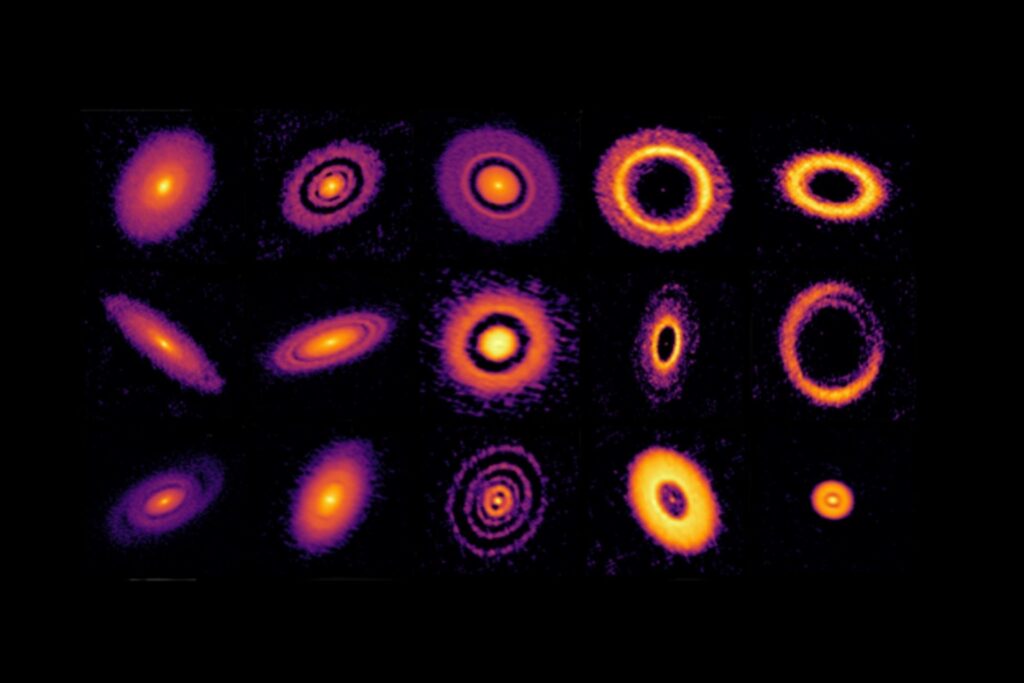
Description: FU Orionis-type objects (FUors) are young stars whose discs undergo sudden accretion outbursts, brightening by several magnitudes within months. These outbursts are thought to be triggered by dynamical processes: disc instabilities, close companions, stellar flybys, or infall from the surrounding cloud. They are therefore a natural laboratory for the connection between disc dynamics and stellar accretion. Our group holds a unique gallery of VLT/SPHERE H-band polarimetric images of six FUors, several of them unpublished, showing spirals, streamers and outflow cavities on scales of hundreds to thousands of au.
The intern will learn how these images are made and what they mean: the physics of dust scattering and polarisation, the polarimetric differential imaging (PDI) technique, and the basics of Monte-Carlo radiative transfer. The core of the project is to build 3D radiative-transfer models of a disc plus envelope or streamer with the open-source code RADMC-3D, produce synthetic polarised-intensity images, and compare them to the SPHERE data. Depending on progress, the intern will apply the models to one of our unpublished datasets and thereby contribute directly to a forthcoming publication.
Skills gained: Python-based image analysis, radiative-transfer modelling, scientific visualisation, and an introduction to high-contrast and polarimetric observations of young stars.
15 brightest protoplanetary discs in Ophiuchus (observed by ODISEA and DSHARP) Credit: Orcajo, S. et al. (2025).
Project 5 Feeding planet-forming discs: hydrodynamical simulations of late infall with FARGO3D
Host: Dr. Philipp Weber (Group of Prof. Lucas Labadie)
Location: University of Cologne
Requirements for applicants
- At least 4 completed semesters in physics or astronomy, with courses in classical mechanics and ideally an introduction to fluid dynamics or astrophysics
- Programming experience in Python; basic familiarity with the Linux command line and with C is helpful but not required
- Interest in numerical simulations and high-performance computing; no prior experience with FARGO3D or RADMC-3D required
- Working knowledge of English recommended but German suffices
Description: Protoplanetary discs were long modelled as isolated systems, but ALMA and SPHERE observations increasingly reveal streamers of gas and dust falling onto discs long after the star has formed. Such late infall can replenish the disc, excite spirals and warps, misalign the inner disc, and trigger the accretion outbursts seen in FU Orionis-type stars. Infall is therefore a key dynamical link between the star-forming cloud and the planet-forming disc, a scale connection at the heart of the Dynaverse cluster.
The intern will set up and run hydrodynamical simulations with the GPU-accelerated code FARGO3D (co-developed by the host) of a protoplanetary disc receiving material from an infalling stream. Starting from an existing, well-tested setup, the intern will explore a small parameter study (varying the mass, angular momentum and impact radius of the infalling material) and analyse how the disc responds: the formation of spirals and rings, changes in the accretion rate onto the star, and the possible misalignment of the inner disc. As an optional extension, the simulations will be post-processed with the radiative-transfer code RADMC-3D to produce synthetic scattered-light (SPHERE), millimetre (ALMA) and near-infrared interferometric (VLTI/GRAVITY) observables, allowing a direct comparison with data obtained by the group.
Skills gained: computational fluid dynamics, running and analysing simulations on GPUs, Python-based data analysis and visualisation, and an introduction to synthetic observations.
test 4
Application procedure
To apply to the program, please complete the application form.
In addition to providing personal information and details about your studies, you will be asked to provide the contact details of an academic referee who can provide a letter of recommendation on your behalf. This could be, for example, a professor whose courses you have taken or your program coordinator. Please provide the referee’s name, academic affiliation, and email address. We will contact your referee at a later stage to request the recommendation letter.
You will also be asked to upload the following documents, combined into a single PDF file:
- CV
- Motivation letter (maximum 1 page / 2,500 characters)
- Transcript of Records covering your completed semesters. If you have just started your MSc program, please submit your BSc transcript together with a list of courses you are currently taking or plan to complete during the current semester.
Please make sure that your PDF file does not exceed 5 MB, and is named `last_name_internship2027`.
Applications will be evaluated by the program coordinator, the EDI coordinator, and the professors and postdocs offering the projects.
Applicants will be informed of the outcome of the selection process by mid-January 2027 at the latest.
If you have any questions about the application process, please contact the program coordinator: Dr Magdalena Baer Radermacher ()
