
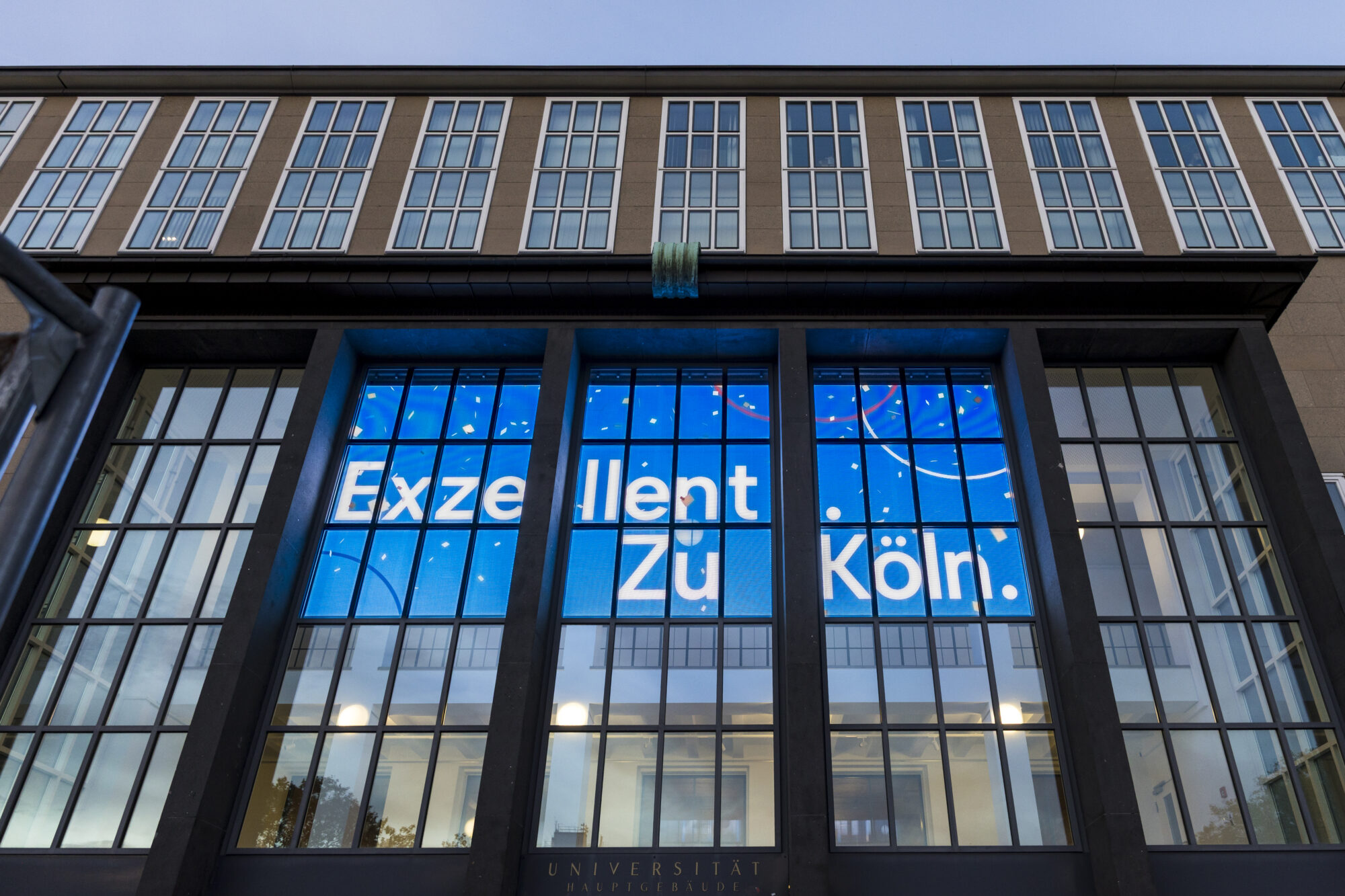
The University of Cologne qualified as one of the 15 universities of excellence, with its funding beginning in 2027. This was announced by the German Science Council (WR), the German Research Foundation (DFG), and the Federal Ministry of Research, Technology, and Space (BMFTR). Dynaverse played a crucial role in the application process since it was able to secure its status as an Cluster of Excellence in 2025.
“Winning this highly competitive competition is a major success for the entire university and the result of the outstanding work of all our researchers, as well as our technical and administrative staff. This success was also made possible by the tremendous dedication of our students,” said Prof. Dr. Joybrato Mukherjee, President of the University of Cologne. “I would like to thank everyone who contributed to and supported the application process with such tremendous dedication.”
A key requirement for the application are at least two Clusters of Excellence, highlighting the importance of the clusters for the overall success of the university. The University of Cologne was recently able to secure funding for five clusters: DYNAVERSE (astrophysics), ML4Q (quantum mechanics), CECAD (aging), CEPLAS (plants), and last but not least ECONtribute (economics). As a spokesperson for Dynaverse, Prof. Dr. Walch-Gassner played an active role in the application process for the university of excellence. The Department of Physics was able to impress the reviewers with a tour presenting state-of-the-art research.
The federal and state Excellence Strategy honors the university’s outstanding research achievements and strategic direction. The funding from 2027 to 2033, which amounts to 100 million Euro, makes it possible to further expand world-class international research and enhance the region’s appeal as a place for research, study, and work.
Under the motto “Neue Universität: Continuous Change – Successful Renewal”, the University of Cologne distinguished itself in this competitive landscape by highlighting its strong strategic partnerships with institutions regionally and globally. These include the University of Bonn and Forschungszentrum Jülich, which also belong to Dynaverse.
The strategy of the University of Cologne sets forth four main objectives: The first is to attract talent through active scouting and to create an inclusive environment at all career levels. In addition, regional and global collaborations with strategic partners are to be expanded. The University of Cologne aims to give back to and serve society by responding to change and more closely linking research, teaching, and knowledge transfer. Finally, it seeks to actively shape change by anticipating long-term shifts and increasing efficiency to ensure adaptability and competitiveness.
More information:
Statement of the University of Cologne
Statement of the German Science Council
Photo Credit: Ludolf Dahmen (University of Cologne)
